Pay in installments of $6.12 with
 ,
,
 and
and

Shipping Estimate
USA
- USA
- CAN
- USA
- CAN
Ships within 48 hours · Estimated delivery Jun 28 - Jul 3
 Promo Codes Available:
For Your Every Summer RSVP, with Code: SUMMER15
Description
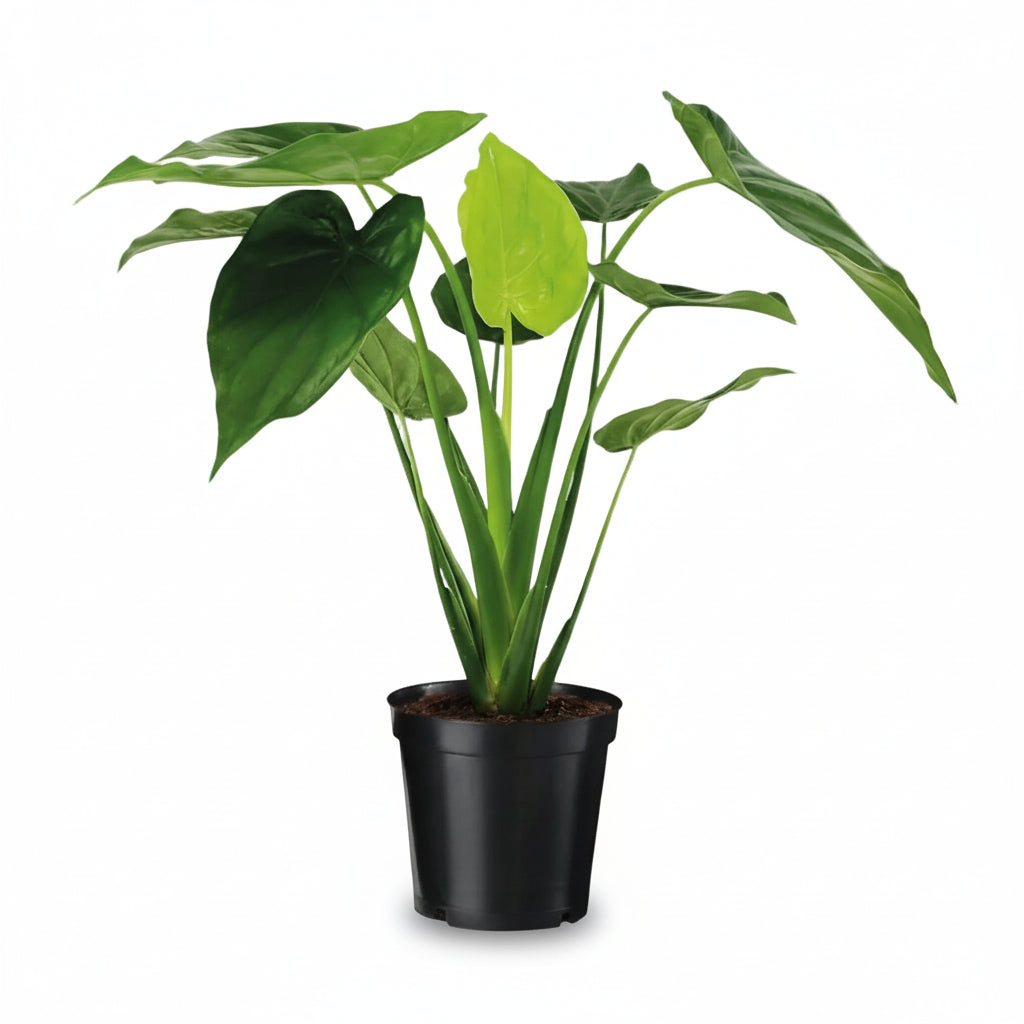
philodendron cucullata Alocasia cucullata — Elephant EarLarge shiny green heart shaped leaves Bright indirect light Moderate watering Vigorous growth 2 sizes available The Alocasia cucullata, also called elephant ear, is a robust tropical plant native to the humid forests of Southeast Asia. Its large shiny green heart shaped leaves borne on long sturdy petioles create a lush, architectural silhouette that brings volume and tropical freshness to contemporary interiors. The cucullata variety is the most
🌿 Large shiny green heart-shaped leaves • ☀️ Bright indirect light • 💧 Moderate watering • 🚀 Vigorous growth • 🏙️ 2 sizes available
The Alocasia cucullata, also called elephant ear, is a robust tropical plant native to the humid forests of Southeast Asia. Its large shiny green heart-shaped leaves borne on long sturdy petioles create a lush, architectural silhouette that brings volume and tropical freshness to contemporary interiors.
The cucullata variety is the most tolerant and robust of the family — it better forgives watering lapses and light variations than other Alocasias, making it the best entry point into the Alocasia collection.
Which Alocasia variety to choose?
The Alocasia genus offers a great diversity of shapes and colors — here are the most distinctive profiles in the catalog:
- Alocasia cucullata (this plant) — large shiny green heart-shaped leaves, smooth and slightly wavy, generous habit. The most robust and tolerant of care mistakes.
- Alocasia Polly (Amazonica) — dark green foliage with very graphic silver-white veins, compact habit. The choice for strong color contrast in a small space.
- Alocasia Zebrina — spectacular yellow and green striped stems, dark green foliage. The choice for stems as decorative as the foliage.
- Alocasia Red Secret — burgundy red foliage shifting to copper green depending on light. The choice for a warm and spectacular palette.
- Alocasia Lauterbachiana — long, narrow wavy leaves on upright stems, very airy habit. The choice for a slimmer, more slender silhouette.
- Alocasia Macrorrhiza — huge shiny green leaves, very imposing stature. The choice for an XXL statement plant in a large, very bright space.
- Alocasia Regal Shield — very large dark green shield-shaped leaves with deep purple reverse. The choice for majestic two-tone foliage.
- Alocasia Wentii — bronze green foliage with purple underside, pronounced veins. The choice for a softer two-tone palette.
Exhibition & location
The Alocasia cucullata enjoys bright indirect light — this is the condition to maintain dense foliage and a vibrant shiny green. Its tolerance for variable conditions makes it one of the Alocasias best suited for intense city living.
- Light: bright indirect to partial shade — protected from direct sun that burns leaves and dulls their shine.
- Locations: living room, office, bedroom — anywhere with stable, diffuse light.
- Temperature: 18 to 27 °C, without sudden changes or drafts.
The Alocasia cucullata is the most shade-tolerant variety in the family — where other Alocasias quickly lose their shine, the cucullata keeps its glossy foliage even in less ideal conditions.
Watering & care
The Alocasia cucullata prefers a slightly moist substrate that never stays soggy — let the top 2 to 3 centimeters dry out before watering. Excess water is its main threat, as with most large tropical indoor plants.
- Frequency: about once a week in spring-summer, every two weeks in winter.
- Drainage: essential — a pot with drainage holes and well-draining substrate, never stagnant water in the decorative pot.
- Humidity: occasionally mist the foliage to maintain a tropical atmosphere.
- Fertilizer: a liquid fertilizer for green plants diluted once a month in spring and summer.
- Cleaning: wipe the leaves with a soft damp cloth to preserve their shiny glow.
If the leaves yellow at the base, it is almost always due to overwatering — let the substrate dry out more between waterings before adjusting light exposure or fertilization.
Decor ideas & plant pairings
The generous silhouette and shiny foliage of the Alocasia cucullata make it an ideal structural plant — its large heart-shaped leaves add volume and height to mixed tropical arrangements without weighing down the overall look.
- For a tropical arrangement at different heights, pair the Alocasia cucullata with a Monstera deliciosa and a Philodendron campii — the shiny heart-shaped leaves of the Alocasia in the foreground, the cut leaves of the Monstera in the middle, and the large leaves of the Philodendron in the background create three very complementary textures within the same palette of tropical greens.
- For a highly contrasting elephant ear duo, pair it with an Alocasia Zebrina — the Zebrina’s striking striped stems contrast with the simple petioles and shiny leaves of the cucullata for a very graphic duo within the same family.
- In a matte white or light gray ceramic decorative pot, the neutral, fresh tones naturally complement the intense shine of the green foliage — choose a matte ceramic decorative pot without pattern so the large leaves are the only decorative accent.
- For a very large arrangement, place the XXL Alocasia cucullata (H80 cm) in front of a Strelitzia nicolai — the broad, heart-shaped leaves of the Alocasia in the foreground and the upright fronds of the Strelitzia in the background create two very distinct tropical layers.
Verdeia tips
- Let the top 2 to 3 centimeters of substrate dry between waterings: Alocasia cucullata is much more tolerant of drought than overwatering — a constantly soggy substrate causes silent root rot that leaves only signal late yellowing.
- Turn the plant a quarter turn every two weeks: Alocasia naturally orients its large leaves toward the light — regular rotation ensures a balanced shape and prevents the plant from stretching toward the window on one side.
- Repot every 2 years in spring in a light, well-draining substrate: Alocasia cucullata develops a robust root system — wait until roots come out of the bottom of the pot and follow the steps in the indoor plant repotting guide to avoid stressing the plant.
Technical characteristics
- Botanical name: Alocasia cucullata
- Common name: Elephant ear, Alocasia Cucullata
- Family: Araceae
- Origin: Tropical forests of Southeast Asia
- Dimensions at delivery: 🏙️ 2 sizes available — H55 cm | Pot Ø19 cm or H80 cm | Pot Ø21 cm
- Exposure: Bright indirect light to partial shade
- Watering: Moderate, let 2-3 cm of the surface dry between waterings
- Temperature: 18 – 27 °C
- Care: Very easy
- Toxicity: Toxic to pets and children (calcium oxalate crystals)
- Decorative style: Tropical / Lush / Architectural
Each plant is unique: the photos show a representative example. Leaf size and foliage density naturally vary depending on light and season.
Shipping Notes
- Free Standard Shipping on $100+ Orders to the USA.
- Except Preorder products are shipped in 48 hours.
- Delivery to the USA:
- Standard Shipping : 3-10 business days
- If time is of the essence, please consider selecting expedited delivery for faster service.
Exchange/Return Notes
- We offer a 30-day return/exchange service after receiving.
- Final sale items are not eligible for returns or exchanges.
- To process your return/exchange, please contact us at [email protected]
- Please click here for more details>>> Return & Exchange Policy