
CARS, Answered
The CARS questions every premed is Googling
Real answers to the things that actually keep you up at night about the Critical Analysis and Reasoning Skills section — from a 99th-percentile scorer and Stanford Medicine grad. Tap any question to open it.
Is CARS really the hardest MCAT section?
For most people, yes — but not for the reason you'd guess. CARS isn't harder because the passages are smarter than the science sections. It's harder because it's the one section you can't beat by memorizing more. There's no content to cram: passages cover philosophy, ethics, and art history — stuff you'll probably never formally study — and the questions test how you reason about an argument you've never seen, under time pressure, with answer choices built to bait you.
That's why people who crush the science sections can still stall out here. The upside: because CARS is a skill, not a pile of facts, it's actually the most improvable section once you train the right way.
See how the CARS course teaches that skill →How do I actually improve my CARS score?
Stop treating it like a volume problem. Doing hundreds of passages without a method just locks in whatever you're already doing wrong — practice makes it permanent. Real improvement comes from changing how you read and reason: read for the author's argument instead of every word, learn to recognize the wrong-answer traps (too extreme, half-right, true-but-irrelevant), and review every miss by asking why the trap was tempting — not just what the right answer was.
That last habit is where most of the gains actually happen, and it's the step most people skip. Build a steady pace you can hold for nine passages instead of sprinting through one.
The CARS course walks you through this exact method →How many CARS passages should I do per day?
Fewer than you think — usually 3 to 5, but only if you actually review each one. One passage you break down completely teaches you more than ten you rush through and grade. The review is the learning; the passage is just raw material.
CARS also takes real focus, and once your reading gets sloppy you're just practicing bad habits while feeling productive. The one rule that holds up is consistency: three passages a day, six days a week, with real review, beats twenty crammed into a Saturday — because skills fade without regular reps.
Get 180+ passages with full breakdowns →How do I read a CARS passage when I'm running out of time?
Read for the argument, not the details. Your goal isn't to memorize the passage — you can always look back — it's to understand what the author is claiming and how strongly, so you could predict how they'd answer. When you read for structure instead of absorbing every word, you answer most questions from understanding instead of frantically re-reading, which is also what makes you faster.
The students who run out of time are almost always the ones who read passively and then have to reconstruct everything during the questions. Fix the reading and the clock mostly takes care of itself. And when an answer just "feels right," slow down — that's exactly when the traps catch you.
Learn the full read-and-reason framework →English isn't my first language — can I still do well on CARS?
Yes — and the evidence is real. CARS doesn't test vocabulary or reading speed; it tests reasoning: analyzing an argument, weighing evidence, and avoiding tempting-but-wrong answers. Those are logic skills, not language ones. One of our students went from a 120 to a 129 on CARS and told us English wasn't her first language.
The two things that actually trip up multilingual students are pacing (an unfamiliar word slowing you down) and second-guessing your own comprehension — and both are fixable. Read for the overall argument so one unknown word doesn't derail you, and lean on a reliable decision process you can trust instead of a gut feeling. Train the process and that "barrier" turns out to be smaller than it looks.
See how the CARS course builds that process →Ready to stop guessing on CARS?
Train the exact reasoning method behind every answer above — built by a 99th-percentile scorer.
Explore the CARS Course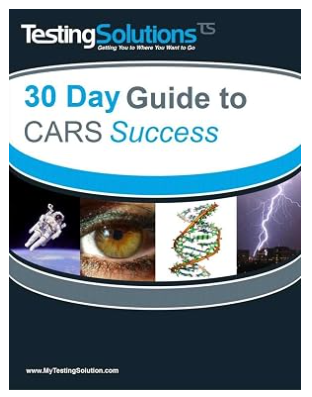
Learn Our MCAT CARS Strategy in 30 Days
Testing Solutions' 30 Day Guide to MCAT CARS Success
Not ready for the complete MCAT course? Start with the book that introduces the Testing Solutions approach to MCAT CARS.
Get the 30 Day Guide on AmazonThe 30 Day Guide to MCAT CARS Success breaks CARS preparation into manageable daily lessons designed to help you develop a repeatable approach to passages, question types, timing, answer elimination, and review.
Build your CARS approach one focused lesson at a time.
Work on argumentation, passage types, keywords, main ideas, and author perspective.
Develop strategies for inference, implication, passage detail, application, attitude, and more.
Learn a process for reviewing passages, questions, answers, and full-length CARS practice.
The 30 Day Guide is an affordable way to learn the foundation of the Testing Solutions CARS methodology. Our online MCAT courses add video instruction, practice passages, detailed explanations, full-length testing, and a much more complete preparation system.
FREE MCAT CARS RESOURCE
Want to Understand How We Approach CARS?
Testing Solutions has been teaching its approach to MCAT CARS since 2015. This free 30-Day CARS Guide, originally developed by Dr. Nick Zehner, founder of Testing Solutions, walks you through the core methodology step by step.
If you want to work through the method on your own, this is a great place to start. It is free, practical, and gives you a good introduction to how we think about reading, reasoning, timing, and reviewing CARS passages.
Our complete CARS prep programs go much further, with video instruction, practice passages, guided strategies, and additional practice to help you actually apply the methodology. But we also realize that not every student is ready to purchase a full prep program.
So start here. Try the methodology for yourself, work through the guide, and see how it works for you.
View the Free 30-Day CARS GuideMCAT Prep Resources
Find the tools, strategy, and practice you need to build confidence, improve your score, and move closer to medical school.
We've Helped More than 5,000 Students from...